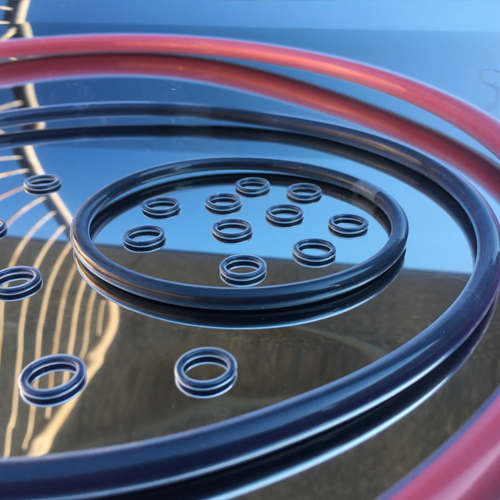
Encapsulated FEP/PFA O-rings

Encapsulated O-rings solve sealing problems in industries involving aggressive fluids. They’re composed of 2 parts: a cover in FEP (Fluorine-Ethylene-Propylene) or PFA (PerfluoroAlcoxy) and an elastomeric core that could be in silicon, FKM (Viton®) or EPDM.
These two parts combined have the chemical resistance of the fluoroplastic materials and the elasticity of the elastomeric core. The cover gives protection from chemical agents and the internal part forms an elastic memory.
INTERNAL ELASTOMERIC O-RINGS
The elastomeric materials used in the O-Rings are:
- FKM (Viton®);
- Silicon;
- EPDM.
FKM (Viton®) has a better “compression set” rate, while the silicon solution is better for low temperature applications or for the food / pharmaceutical industry. EPDM is used only for special applications at the customer’s request.
COVERING
The cover can be in FEP or PFA. Both of these materials conform to the following regulations:
- FDA 21CFR. 177.1550
- EC 1935/2004 - UE 10/2011
- 3A Sanitary Standard
- USP Class VI <87> & <88>
FEP is the standard choice, while PFA is used at higher temperatures.
WORKING TEMPERATURES
- combination SILICON/FEP : -60°C / + 200°C
- combination VITON /FEP : - 20°C /+ 204°C
- combination SILICON/PFA: - 60°C / + 260°C
- combination VITON /PFA : -20°C/+204°C
APPLICATION BENEFITS
- Great thermal resistance and chemical compatibility
- Good strain and compression resistance
- No joints on FEP/PFA covering
- Non-contamination for food/pharmaceutical industry
- Smooth and non-adherent surface
- Low steam permeability
- Cross-sections from 1,60 from 20,00 mm
- No mold or equipment costs
These two parts combined have the chemical resistance of the fluoroplastic materials and the elasticity of the elastomeric core. The cover gives protection from chemical agents and the internal part forms an elastic memory.
INTERNAL ELASTOMERIC O-RINGS
The elastomeric materials used in the O-Rings are:
- FKM (Viton®);
- Silicon;
- EPDM.
FKM (Viton®) has a better “compression set” rate, while the silicon solution is better for low temperature applications or for the food / pharmaceutical industry. EPDM is used only for special applications at the customer’s request.
COVERING
The cover can be in FEP or PFA. Both of these materials conform to the following regulations:
- FDA 21CFR. 177.1550
- EC 1935/2004 - UE 10/2011
- 3A Sanitary Standard
- USP Class VI <87> & <88>
FEP is the standard choice, while PFA is used at higher temperatures.
WORKING TEMPERATURES
- combination SILICON/FEP : -60°C / + 200°C
- combination VITON /FEP : - 20°C /+ 204°C
- combination SILICON/PFA: - 60°C / + 260°C
- combination VITON /PFA : -20°C/+204°C
APPLICATION BENEFITS
- Great thermal resistance and chemical compatibility
- Good strain and compression resistance
- No joints on FEP/PFA covering
- Non-contamination for food/pharmaceutical industry
- Smooth and non-adherent surface
- Low steam permeability
- Cross-sections from 1,60 from 20,00 mm
- No mold or equipment costs